PAIN RELIEVING EFFECTS OF ACUPUNCTURE
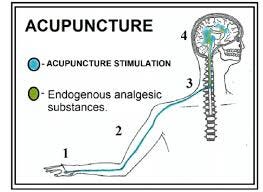
According to an article in Scientific Basis of Acupuncture by Bruce Pomeranz, the papers reviewed below indicate that AA is very effective in treating chronic pain, helping 55% to 85% of patients( compared to morphine which helps 70%). Secondly, these papers show that AA is better than placebo which helps only 30% of patients. These statements are based on evidence collected in four classes of studies.

CLASS A: studies in which there was no control group for comparison with the acupuncture group or in which there was a control group where the subjects received no treatment.
CLASS B: studies in which the control group received percutaneous acupuncture but at the wrong location( called sham acupuncture).
CLASS C: studies using a placebo control group(usually a disconnected TENS device or acupuncture needle taped to the skin). It is important to note that needles were not inserted percutaneously in the control group for class C studies and hence this is not considered to be sham acupuncture.
CLASS D: studies in which the control group received conventional therapy(e.g. drugs or physiotherapy).
In classes B and C, the experiments were single-blind ( the patients did not know about the sham or placebo, but the therapist knew). The quality of studies in descending order is class C, class D, class B, and class A. Initially, it was thought that class B studies were similar in quality to those of class C. It was hoped that sham acupuncture was a good control for placebo effects and, hence many studies were based on this approach. Unfortunately, experience has since shown that sham acupuncture helps 33% to 50% of patients while a placebo in class C helps only 30% of patients( note that true acupuncture helps 55% to 85% of patients).
It was convincingly argued that the statistical problems inherent in class B experiments, in which one group shows a 40% success rate(sham) and another group shows a 40% rate(true acupuncture), make the burden of proof unrealistic, requiring at least 122 patients in the study to find a difference between the two groups. In contrast, placebos in class C only benefit 30% of patients, making the burden of proof easier. To compare 30% success in placebo controls with 70% success from true acupuncture requires only 70 patients. Hence, it is not surprising that two studies in class C showed significant differences between treated controls, whereas four out of six class B experiments failed to show differences. Class B experiments should be repeated with a larger sample size, above 122, to settle this problem.
Normally we should completely ignore class A experiments as they are poorly controlled. This is too severe as most of these studies showed the 55% to 85% success rate that we know from class C experiments to be far above the placebo level of 30%.
Class D studies suffered from the same problems as class B, placing too big a burden of proof on the small sample size. Nevertheless, four of these studies did show AA to outperform conventional medical treatment, while one showed no difference.
However, even if the analgesic effects of acupuncture and a chemical analgesic are equivalent, this is also a victory for ACUPUNCTURE ANALGESIA, given the many side effects of analgesic drugs and the relatively no side effects of acupuncture.
Hence, from the above considerations, it is clear that AA helps from 55% to 85% of patients which compares favorably with morphine(but with fever side effects). It works better than a placebo, but more research is needed to see if it works better.

.jpeg)

Comments
Post a Comment